 Skip to content

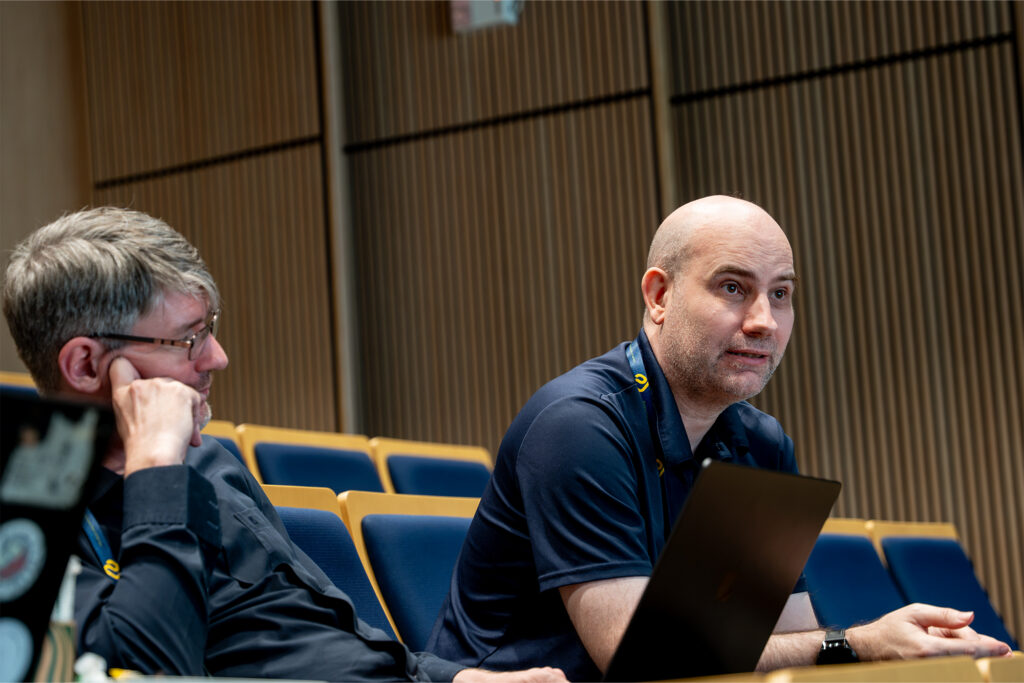
Fifteen minutes before it started, people were already squeezing into the room. By the time James Abela, Director of Digital Learning and Entrepreneurship at Garden International School, began, chairs were being pushed together to fit everyone in. The promise was simple: no coding experience needed, and everyone leaves with an app they can use on Monday morning.
He delivered. But before anyone typed a prompt, James made the room say the most important word out loud, together: safeguarding.
1. Vibe coding is sketching, not engineering
The term “vibe coding,” coined by AI researcher Andrej Karpathy, describes a new way of building software. You describe what you want, the AI writes the code, and you build, observe and improve. As James put it, the limit now is our imagination rather than our knowledge of syntax.
For teachers, that opens up engaging lessons, personalised learning and tools that save time. The strengths are real: speed, a very low barrier to entry and creative momentum. So are the risks.
2. Beware the word “just”
James called “just” one of the most dangerous words in English. “Can I just make it multiplayer?” “Can it just give me a dashboard of marks?” These sound small, but each means student data leaves your computer and goes to a server somewhere.
In the previous three weeks alone, he said, he had dealt with a stream of safeguarding issues from well-meaning vibe coding.
His rule of thumb:
- Usually safe: simulations, quizzes, games and teaching tools that run only in the browser.
- Red flags: saving data, user accounts, external APIs, file uploads, links to other services and Google or Microsoft sign-in.
Any red flag means a review by your school’s Data Protection Officer (DPO). If your school doesn’t have a competent one, that needs fixing, and the person may end up being you.
3. Let the AI write the prompt
Remember when prompt engineering was going to be a career?
The models got smarter. James’s shortcut is to ask the AI to write the prompt first (“make me a prompt for a triangle game”), check it, and only then ask it to build.
Writing language is easy for a language model. Building a game is not, so a strong prompt saves time, errors and energy.
His other practical tips include:
- Start small. A six-question quiz with instant feedback, a drag-and-drop matching task, a spin-the-wheel picker or memory flip cards each take three to five minutes to make.
- Save every working draft. The second version isn’t always better than the first, and by the seventh the AI may break everything. Copy each good version into a doc.
- Shop around. Give the same prompt to two different models and keep the best. James also shared a favourite trick: tell one model that another did a terrible job, and watch it try harder.
- Pick your tool with data in mind. The method works in Gemini, ChatGPT, DeepSeek and others. The real choice is whose servers you are comfortable sharing data with.
4. From prototype to published in minutes
Then came the reveal. Type sites.new into a browser and you get a brand-new Google Site.
Google Sites also acts as a basic safety check: it blocks some unsafe code, and if your app won’t embed, that’s a cue to ask your DPO. Google schools can also limit the site to their own domain.
For colleagues in China, James suggested GitHub, the school’s local network, or simply saving the app as an HTML file.
5. Start with people, not code
James closed his session on design thinking: empathise, define, ideate, prototype, test. Asking students “who could you help with this?” rather than coding for its own sake has changed who signs up for computer science at his school.
It has also helped bring more girls into coding. Some of his A-level classes now have more girls than boys. A win!
At the end of the day, AI is here to enhance us, not replace us. Understanding what people actually need is still a deeply human skill. And as soon as a project needs a database or back end, it can’t be vibe-coded securely. That is one reason demand for cybersecurity skills has risen.
The takeaway: build boldly, share carefully
By the end, the room had produced everything from a kinematics lab reimagined as an Ancient Greek boating simulation to a mini-site on the choices of Julius Caesar. James’s final challenge: anyone who didn’t have something for Monday could come and tell him, and he’d find them a ready-made tool for any subject.
Vibe coding puts real creative power in teachers’ hands. The lesson from this session is to use it freely for front-end tools, and to pause every time you hear yourself say “just.”
Hands-on sessions like this are what AI and the Future of Education (AIFE) is built for: practical ideas from educators exploring what AI means for teaching and learning. Join us at AIFE Dubai on 14–15 May 2027.
This blog post is generated by using an AI tool via audio recording of the actual sessions with consent from the presenters. The final product is also reviewed by both the organizer and presenters to ensure accuracy of information.
 LinkedIn
 X
 WhatsApp
 Bluesky
 Telegram
 Facebook