


Throughout my career, I have watched capable educators move into leadership roles because they excelled at their work. They knew their craft, worked hard, earned their colleagues’ respect, and delivered results. When they became leaders, the work changed. Personal effectiveness was no longer enough. Success now depended less on what they could accomplish themselves and more on their ability to help others think, learn, decide, navigate disagreement, and move toward something together.
I have experienced this transition firsthand, and I continue to see it unfold among leaders at every level of schools. It has made me rethink what we mean by “preparing someone for leadership.” An important distinction exists between learning about leadership and preparing to lead.
From “ME” to “WE”
Early leadership development should focus on self-awareness, communication, relationships, and leadership identity. We need to understand ourselves before we can lead others effectively. However, at some point, that development must cross a threshold. The question shifts from Can I be an effective leader? to Can I help a group of people become more effective together?
That is a fundamentally different challenge. Spillane, Halverson, and Diamond (2001) helped shift leadership thinking away from the idea that leadership resides primarily in an individual position. From a distributed perspective, people enact leadership through interactions among people, situations, routines, and structures. That matters for leadership preparation: we cannot develop leaders only as individuals, because leadership happens in relationship with others.
Knowing how to run a meeting is useful. Knowing a change framework is useful. Understanding conflict styles is useful. However, none of that guarantees that a leader can walk into a complicated situation, listen carefully, sense what is happening beneath the surface, bring different perspectives into the conversation, and help a group decide what to do next. That takes more than knowledge.
Professional capital, not simply individual expertise
Hargreaves and Fullan (2012) offer a useful lens here: professional capital comprises three interconnected forms of capacity. Human capital is what we know and can do. Social capital is the relationships, trust, and networks through which we learn and work with others. Decisional capital is the professional judgment we develop through experience, reflection, and repeated opportunities to make decisions in complex situations.
Leadership preparation tends to invest heavily in the first. We teach theories, frameworks, strategies, and technical skills, and those things matter. However, human capital alone is insufficient. A leader may know a great deal about change and still struggle to build the trust needed to lead it. A leader may understand multiple decision-making frameworks and still struggle to exercise judgment in ambiguous situations. A leader may be exceptionally capable individually and still, without meaning to, limit the capacity of those around them.
Leadership requires expertise, relationships, and judgment working together, a claim my dissertation research helped sharpen. I studied educators in a sustained, cohort-based professional learning program and examined how they perceived the development of their professional capital. Participants consistently described collaboration, structured reflection, authentic application, and professional networks as central to their growth. More strikingly, they did not view human, social, and decisional capital as separate. They described them as mutually reinforcing: as they developed expertise, they gained new perspectives from others; those relationships gave them places to test ideas and receive feedback; applying what they learned created opportunities to make decisions; and reflection helped them reconsider those decisions. Over time, many also described increased confidence, professional agency, and readiness to take on leadership responsibilities (Sheridan, 2026).
One implication I keep coming back to: knowing more can make someone more knowledgeable without making them more prepared to lead.
From individual confidence to collective efficacy
Another shift matters as people prepare for leadership. We often focus on whether an individual feels capable of doing the work. However, leadership ultimately requires a different question: Do the people in this group believe we can accomplish something together?
Collective efficacy research defines it as a group’s shared belief in its capacity to achieve desired outcomes (Goddard, Hoy, & Hoy, 2000). This definition more closely reflects the real work of leading teams. Strong leaders do not just bring expertise into a room. They create conditions that surface, challenge, combine, and put to use the expertise already in the room. They build trust, help people make sense of complexity, create room for meaningful participation, favor inquiry over quick answers, and help teams develop confidence not only in the leader but also in one another.
This is where leadership preparation should begin: moving from individual competence to collective capacity. This matters enormously for change, too. Schools are complex organizations, and most meaningful improvement requires people to reconsider existing practices, test new approaches, work through disagreement, interpret evidence, and adjust along the way. A leader cannot simply know the answer and convince everyone else to implement it. The capacity to lead change is closely tied to the capacity to learn with others.

So what should preparation actually look like?
This brings me back to how we design leadership development. If leadership is relational, contextual, and dependent on professional judgment, preparing leaders cannot primarily mean giving them more leadership content. They need opportunities to practice the work.
Effective professional learning already offers some clues. Darling-Hammond, Hyler, and Gardner (2017) identified collaboration, active learning, feedback and reflection, modeling, expert support, and sustained duration as features of effective professional development. My own research pointed in a similar direction: participants described the interplay among sustained collaboration, reflection, authentic application, feedback, and professional networks as especially important to their development (Sheridan, 2026).
Leadership preparation should create similar conditions: opportunities to examine authentic problems, engage with relevant research and frameworks, test ideas with trusted peers, hear perspectives from different contexts, make decisions, take action, and then return to examine what happened. What worked? What did not? What assumptions proved wrong? What evidence emerged? What would they do differently next time? The developmental value comes not from doing this once but from repeating the cycle over time.
This thinking is shaping a leadership development program I am helping build for international school educators and leaders. During the preparation phase, the focus intentionally shifts from Leading Self and Leading Others to Leading Teams and Leading Change. The goal is to create repeated opportunities for leaders to build the professional capital, collective efficacy, and judgment needed to lead teams and drive change.
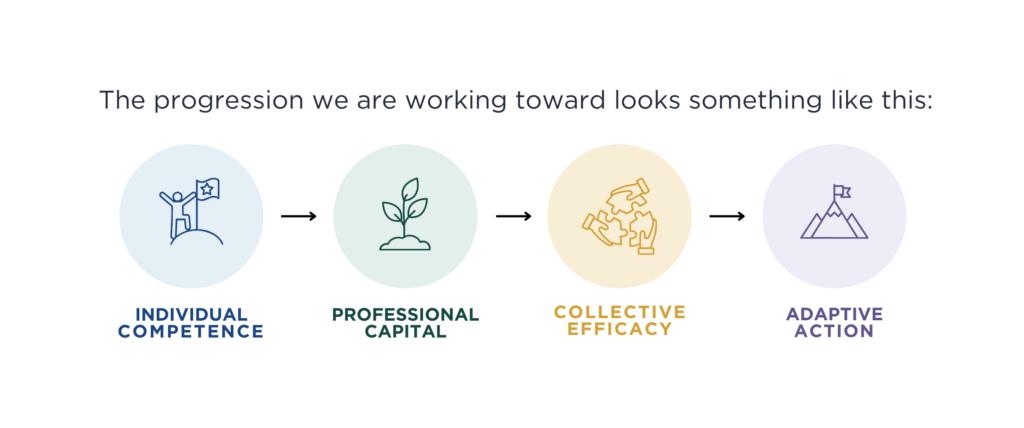
That progression has changed how I think about the word preparation. We cannot prepare leaders by handing them answers to situations they have not yet encountered; contexts, people, and challenges will always change, and what works in one school may fail in another. What we can offer developing leaders is repeated opportunities to think, collaborate, decide, act, reflect, and refine their practice alongside others.
Perhaps the real purpose of leadership preparation is not to make future leaders certain about what to do, but to make them increasingly capable of learning, deciding, and acting with others when the answer is uncertain.
References
Darling-Hammond, L., Hyler, M. E., & Gardner, M. (2017). Effective teacher professional development. Learning Policy Institute.
Goddard, R. D., Hoy, W. K., & Hoy, A. W. (2000). Collective teacher efficacy: Its meaning, measure, and impact on student achievement. American Educational Research Journal, 37(2), 479–507.
Hargreaves, A., & Fullan, M. (2012). Professional capital: Transforming teaching in every school. Teachers College Press.
Sheridan, B. J. (2026). The relationship between participants in the Certificate of Educational Technology and Information Literacy (COETAIL) program and professional capital [Doctoral dissertation, University of Kentucky].
Spillane, J. P., Halverson, R., & Diamond, J. B. (2001). Investigating school leadership practice: A distributed perspective. Educational Researcher, 30(3), 23–28.


 LinkedIn
 X
X
 WhatsApp
 Bluesky
 Telegram
 Facebook