

Technology leaders in international schools work in an odd spot. They are asked to shape how a whole school teaches, learns and operates. Most of them do it without line authority over the teachers, principals or departments they need to bring along. And the ground under them keeps moving. As John Mikton of the International School of Geneva reminded us, quoting our facilitator Warren Apel: the tool you’re using today is the worst tool you’ll ever use.
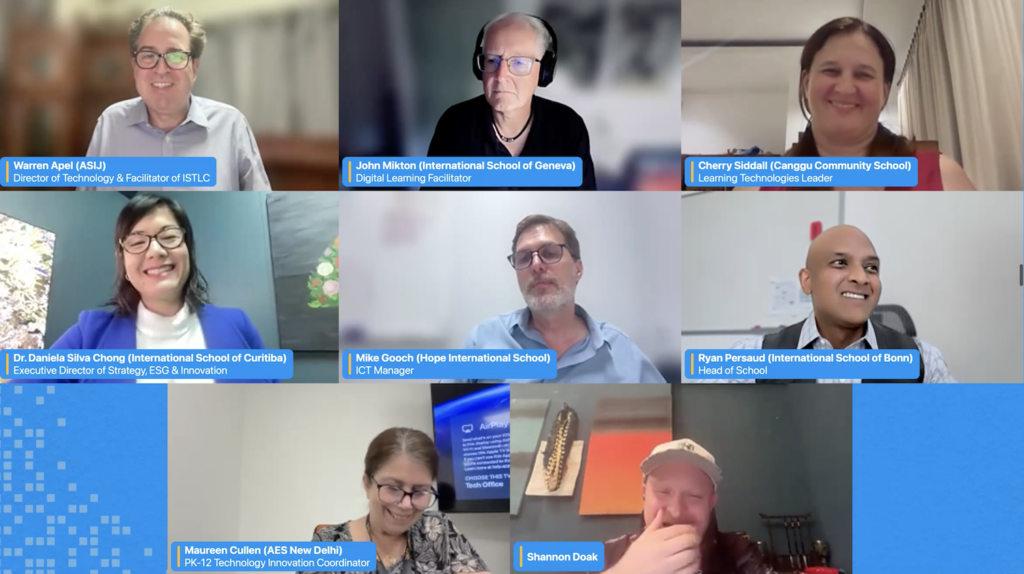
We recently brought together a panel of technology leaders from across the international school world to talk about how they handle this. Warren Apel facilitated. The panel included Ryan Persaud (Head of School, International School of Bonn), John Mikton (International School of Geneva), Dr. Daniela Silva Chong (International School of Curitiba), Dr. Shannon Doak (Nanjing International School), Cherry Siddall (Canggu Community School), Mike Gooch (HOPE International School) and Maureen Cullen (American Embassy School, New Delhi). Here is what stood out.
Measure by learning impact, not newness
On AI, the panel agreed that being first isn’t the goal.
“Just because it’s new, it doesn’t mean we have to adopt it”
said Daniela Silva Chong. Before anything is adopted, her school looks hard at whether it actually helps teachers or students, or whether it just replaces something that already worked.
The International School of Curitiba goes a step further with what Daniela calls educational pruning: deliberately removing tools that add cognitive load without adding value. Most schools find it easy to add things. Few build in a regular habit of taking them away.
Shannon Doak described a clear filter. Compare any new tool with the school’s mission, vision, strategy and definition of learning. If it fits, pilot it. If the pilot works, commit to it for at least three years before reviewing it again. “You’re going to use it for quite some time so that you can learn to do it well.” Mike Gooch put it simply: avoid the shiny object.
Anchor decisions in values, not tools
John Mikton moved the question away from tools altogether. If the tools are going to keep getting better, he asked, what is the value that won’t change?
“What is the non-negotiable that your school is willing to commit to long-term when uncertainty and change are constantly coming at it?”
When a school is clear on its “moral pedagogic compass,” John argued, change gets easier to handle. New tools will keep arriving in different forms, but the compass stays put and acts as the filter.
Maureen Cullen added a non-negotiable that should be on every school’s list: child safeguarding and data protection. Tools that give students sensible starting guardrails are the ones her school chooses to support.
Make room for the conversation, and widen who’s in it
Things are changing too fast for a one-off decision. Ryan Persaud described giving AI a standing place in his school’s committee structure for the whole year. He stressed that the room needs a real cross-section of the school: people from primary, middle and high school who use these tools every day and can say what’s working, what’s overwhelming and what should be pruned.
The panel pushed for even wider voice:
- Students. Several schools run student pilots and include student representatives in AI governance groups. Students give feedback on the tools and on the wording of AI policy. Warren noted that some of the most useful feedback he gets comes from 9th and 10th graders. They say what they think but aren’t power users, so they show quickly how much teaching a tool will actually need.
- Support and administrative staff. John made the case for a group that’s often missed. Office and support staff increasingly depend on these tools for their workflows, and they see them through a completely different lens.
Cherry Siddall also showed where the strategy meets real students. With Year 13 IB deadlines approaching, her school teaches responsible AI use through its core program, with a traffic-light system that now extends to younger year groups.
Lead through influence: slow down to speed up
The best of the conversation came when Warren asked how technology leaders lead without positional authority.
Ryan Persaud has been both a tech director and a head of school. He said the job demands that you be “a good negotiator and a good collaborator and a little bit of a good salesperson.” That means showing clearly how something benefits teachers and, in the end, students.
John Mikton argued for patience. “Be willing to be a bit of a tortoise,” he said. He described the practice of 100 conversations when you arrive at a new school:
“You talk to everybody: the bus driver, the cook. And it’s amazing what kind of information you get of what is working and not working. Because the SIS might be working for a teacher, but for the cafeteria staff, it is a total nightmare.”
Knowing that one principal likes to deliberate and another likes to act tells you how to approach each of them. Daniela called this building relational capital: learn names, stories and the “sacred cows” before you try to move anything. She also encouraged technology leaders, who are often not the loudest people in the room, to trust what they know and speak up. “Making mistakes is okay.”
Other panelists added practical habits:
- Build trust as a person, not just a colleague. Shannon walks the building, drops into classrooms and asks about pain points and about people’s weekends. “Technology isn’t about tech. It’s about the service industry.”
- Be the teachers’ advocate, and bring data. Maureen sees her role as spotting patterns in what teachers are struggling with and taking specific evidence (“I was at this meeting and I heard this”) to the people who decide.
- Make it easy. Cherry’s approach is to meet people where they are and design each request so it takes as little effort as possible, because teachers often see technology work as an add-on.
- Show the time savings. Mike noted that a veteran teacher becomes an advocate the moment you show them a 20-minute daily task can take two minutes.
- Drop the jargon. Ryan warned that technical leaders can slip into a language that heads, curriculum directors and principals don’t speak. Plan your communication so everyone in the building can see what you’re trying to do and why it matters to them.
Bridge IT and teaching and learning by design
The last theme was the gap between the operational IT side and the pedagogical side. The panel’s advice: don’t wait for the two sides to meet on their own. Build situations where they have to.
- Cross-pollinate. John used to send his technicians into classrooms. One came back amazed at how much assessment teachers were juggling. One of his principals asked to spend a day on the help desk. Shared experiences like these build empathy in both directions.
- Co-locate. At AES, integrators and IT now share an office. When a ticket comes in, they look at it together and work out whether it’s a Google Admin setting, a PowerSchool issue or a classroom workflow problem. It’s collaboration just when it’s needed.
- Make the reasons visible. At Curitiba, departments regularly show their work to the rest of the school. IT maps out compliance, risk, data protection and safeguarding so that when the answer is “not that tool,” teachers understand why. Daniela reports better buy-in from teachers, operational staff and even students.
The takeaway
Across the hour, the panel kept landing on the same point: technology leadership is mostly about people. The tools will keep changing. Clear values, trust, patience, and making room for every voice in the building are what last.
These themes are at the heart of the International School Technology Leadership Certification (ISTLC), a three-day in-person program for technology leaders from education, IT and corporate backgrounds. Upcoming cohorts run in Hong Kong, Bonn and Dubai.



 LinkedIn
 X
X
 WhatsApp
 Bluesky
 Telegram
 Facebook