


Insights from Education Vanguard Podcast
This insights document is based on insights from Ewan McIntosh, founder of No Tosh and specialist in school brand strategy, shared in conversation with 21CL on the Education Vanguard Podcast.
“A good strategy, mission or vision is a start. But every communication has to lift those words off paper and into people’s imaginations. Frameworks get you so far; but those daily communication habits are where you bring your brand alive.”

What Is Brand, Really?
Brand isn’t your logo, your slogan, or your marketing materials. Brand is what other people say about you. Marketing is what you say about yourself—brand is the conversation happening at dinner tables, in parent WhatsApp groups, and between colleagues at the coffee machine.
Every school has a brand, whether they’ve intentionally shaped it or not. The question is: do you know what people are actually saying, and does it reflect what you want them to understand about your school?
The Three Questions Every School Must Answer
Before investing in new campaigns, refreshed websites, or polished videos, sit with these questions:
What is your brand? Can you articulate in plain language what makes your school distinctive—not in educational jargon, but in words a grandparent or new-to-town family would immediately understand?
Does anyone know it? Is your brand identity clear to your teachers, your admissions team, your current families? When someone asks a parent at a party “What’s your school like?”, can they answer confidently and consistently?
Does anyone care? Does your brand connect to something families actually value, or are you communicating things that sound impressive but don’t influence decisions?
Brand and Strategy: Partners, Not Sequence
A common misconception is that brand strategy comes after school strategy is complete. In reality, they must develop together. Your head of school is your chief communicator—every weekly email, every assembly speech, every conversation with prospective families shapes perception. If your brand team and your leadership team work in isolation, you’ll end up with beautiful messaging that doesn’t match the lived experience, or a strong school culture that nobody outside understands.
The person responsible for your brand should be close enough to leadership that they’re part of strategic conversations, not just handed decisions to communicate after the fact.

The Right to Win
Many schools claim similar strengths: “holistic education,” “academic excellence,” “nurturing environment,” “international mindset.” The problem is that your competitor can say exactly the same things. When everyone claims the same territory, no one stands out.
The critical question becomes: What is your right to win in the space you’re claiming? This isn’t about what you wish to be known for—it’s about where your authentic strengths, your community’s values, and genuine market differentiation intersect. If you can’t defend your claim with evidence and stories that only you can tell, you’re competing on territory anyone can occupy.
From Telling to Showing
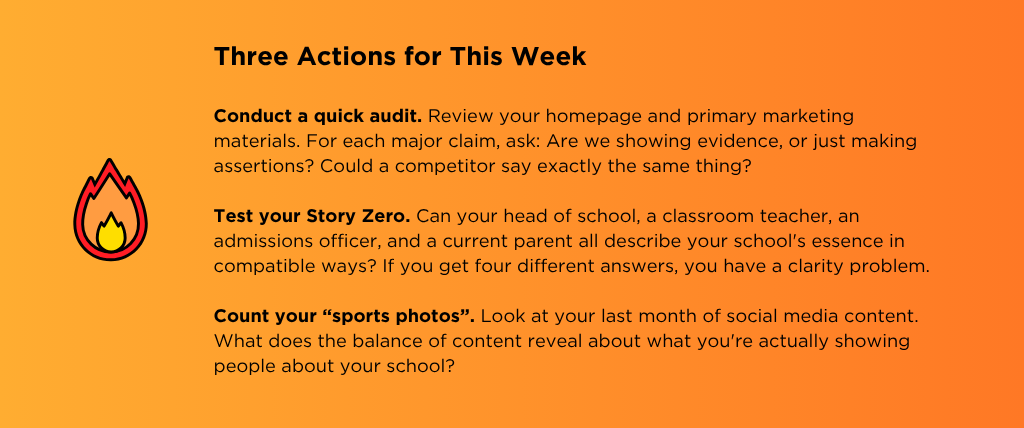
Audit your own website right now. How much of it tells people what you are (“We are academically excellent”) versus shows them through specific examples, stories, and evidence?
Most school websites are filled with declarations. “We develop the whole child.” “We prepare students for a changing world.” “We foster creativity and critical thinking.” These statements require belief without proof.
The schools that cut through are the ones that show: a specific story about how a student approached a problem, a glimpse into how a particular lesson unfolded, a moment that captures your culture in action. When you show rather than tell, you become distinctive by default—because no one else has your exact stories.
The Plain Language Advantage
Educational jargon creates distance. When your website talks about “inquiry-based pedagogical approaches” or “differentiated learning modalities,” you’re speaking to other educators, not to the families trying to make one of the most important decisions of their lives.
Translate what you do into language anyone can understand. Describe what actually happens in your classrooms as if explaining to a thoughtful friend who knows nothing about education. This simple act—describing reality in plain terms—often reveals what’s genuinely special about your school. The authentic story, clearly told, is more compelling than any polished slogan.
The “Sports Photo” Problem
Here’s a diagnostic question: Does your communications team spend their days being pulled across campus to capture whatever’s most photogenic at any given moment?
If your Instagram feed is dominated by sports matches, musical performances, and smiling students at events—but rarely shows the intellectual life of your school—you may have a brand clarity problem. When you don’t know what you’re trying to show, you default to what’s visually obvious.
A school with clear brand identity can make a maths lesson as compelling as a championship game, because they know what they’re revealing about who they are through every piece of content they share. The question isn’t “What looks good?” but “What does this show about what we stand for?”
The Story Zero
Every school needs what might be called a “Story Zero”—the foundational narrative from which all other stories emerge. This isn’t a tagline or mission statement. It’s the essential truth about your school that, once articulated, makes every other communication decision easier.
When you have Story Zero clear, you can evaluate any opportunity, any request for coverage, any speech through a simple filter: Does this reinforce our core story, or does it dilute it? Teachers know why certain initiatives get supported. Parents can explain your school to others. Your head of school can speak with consistency whether they’re at a board meeting or a casual coffee with prospective families.
Relentless Positivity
Strong brands resist the temptation to define themselves against competitors. When a competitor makes claims that feel unfair or inaccurate, the instinct is to respond with “No, actually we’re the real…” But defensive positioning keeps you in someone else’s conversation.
The alternative is relentless positivity—consistently articulating what you stand for without reference to what others lack. This isn’t naive optimism; it’s strategic discipline. It allows you to control your own narrative and projects confidence that attracts rather than arguments that exhaust.

Students as Brand Ambassadors
Student voices can be powerful in communicating brand—but only when authentic. The student who’s been coached to deliver talking points, or the IB Diploma student who’s learned to speak in institutional language, can feel less genuine than saying nothing at all.
The most effective student voices come from unscripted moments: roundtable conversations where the initial performance gives way to honest reflection, casual interactions with prospective families, or observations from daily school life. If you’re going to feature students, invest the time to capture them being genuinely themselves rather than performing what they think you want.
The Internal Brand Effect
Brand strategy isn’t only about attracting families. When your school’s identity is clear, teachers understand why certain initiatives succeed and others don’t. New hires can self-select based on genuine fit. Parents engage with appropriate expectations. Leadership can make consistent decisions without relitigating values in every conversation.
A clear brand creates coherence that makes every part of the organization more effective. It’s not just about external perception—it’s about internal alignment that shows up in culture, decision-making, and daily experience.
Starting the Work
Brand strategy requires honest assessment and collaborative development. It cannot be delegated entirely to a marketing team or imposed by leadership—it emerges from understanding what your school genuinely is and finding the words that make that truth compelling.
Begin by listening: to current families about why they chose you, to departed families about why they left, to prospective families about what they’re seeking. Compare what you discover with what you’re currently communicating. The gaps between reality, aspiration, and perception reveal where the work needs to focus.



 LinkedIn
 X
X
 WhatsApp
 Bluesky
 Telegram
 Facebook